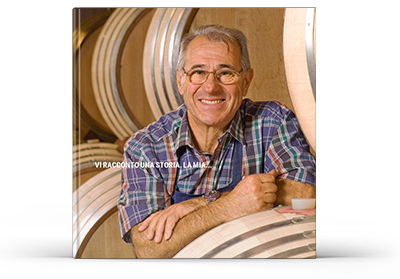
Download the book in PDF and let yourself be guided
through a story that intertwines a man, his land
and the family that preserves his legacy.
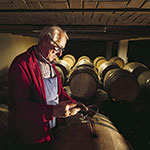
Between 2011 and 2014, the Luciano Sandrone Farm faced another important project to expand the cellar structure with the creation of the south-facing wing of the company building to better house agricultural equipment and machinery and provide rational space for vinification systems and new, even more functional underground rooms dedicated to the preservation of historical vintages.
"This was another important piece – Luciano recalls with pride – aimed on the one hand at working with greater efficiency during the vinification of the grapes and, on the other, at guaranteeing more effective preservation of the historical vintages of our wines. Economically it was another important commitment, but it was carried out with conviction precisely for the greater certainties and concrete results that the company could obtain".
In the spring of 2014, during the course of the Giro d'Italia cycling race, on May 22, the time trial stage between Barbaresco and Barolo was run, passing right in front of the Sandrone cellar. That circumstance was the occasion to gather some friends in the cellar and celebrate together a sport to which many people at Sandrone's house – starting with Barbara and Luca – were particularly attached. From that day and still now, a stylized bicycle stands in front of the cellar in memory of that event and as evidence of a simple but pleasant way to travel through the hills and valleys of this land and remind everyone that the environment around us must be respected and protected.
In June 2014, after a process that lasted a few years, the "Vineyard Landscapes of Langhe-Roero and Monferrato" were included in the list of World Heritage Sites, becoming the fiftieth Italian UNESCO site and the first as a vineyard cultural landscape at the national level.
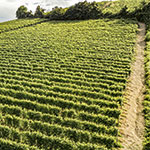
The site identified six main areas, defined as "core zones" and considered more representative of local wine culture and its influence on the landscape, located in the provinces of Alessandria, Asti and Cuneo and more precisely three in the territory of the Langhe (The Langa of Barolo, the Castle of Grinzane Cavour and The hills of Barbaresco), two in that of Alto Monferrato (Nizza Monferrato and the Barbera and Canelli and the Asti Spumante) and one in Basso Monferrato (The Monferrato of the Infernòt). Even now, all of them represent, each in its own way, the suggestive beauty and the rooting of viticulture in the Piedmontese landscape. In all there are almost eleven thousand hectares of vineyards out of about 44 thousand of the entire regional surface. All around a "buffer zone" was identified with the aim of protecting the site and giving continuity to the passage between the territories: over seventy thousand hectares involving a hundred municipalities.
Some time after the start of the project, few remember the infinite discussions that involved the municipalities and individual citizens, wine producers, restaurateurs and other operators. Someone even feared the risk of remaining bound to protection rules capable of preventing the viticultural and economic development of the areas themselves. Nothing could be more wrong, given the results that in terms of valorization and identity this recognition brought to the Piedmontese reality. The UNESCO recognition generated two important effects:
A new attitude that little by little has favored a complete view of the territory and its landscape, to the advantage of the ability to project with confidence towards the future and the new generations.
The 2000 vintage continued regularly and, at the end of the work in the vineyard, a "top-notch" harvest brought precious grapes to the cellar, capable of generating wines of great satisfaction.
The passage from 2002 to 2003 brought a radical change in the climate situation. In fact, many researchers had been talking about "climate change" since the previous decade, but the majority of producers only noticed it that year.
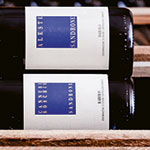
In 2004, with the presence in the company of larger spaces, including some air-conditioned warehouses and, therefore, suitable for the preservation of bottles of great vintages intended to be consumed in the following years
Meanwhile, in the last part of 2004, the process of sector organization and qualification of the Roero wine world was concluded.
As the years passed, the Piedmontese wine world also continued to organize itself.
In 2017, the 2013 Barolo completed its mandatory period of maturation and refinement.
Download the book in PDF and let yourself be guided
through a story that intertwines a man, his land
and the family that preserves his legacy.