Download the book in PDF and let yourself be guided
through a story that intertwines a man, his land
and the family that preserves his legacy.
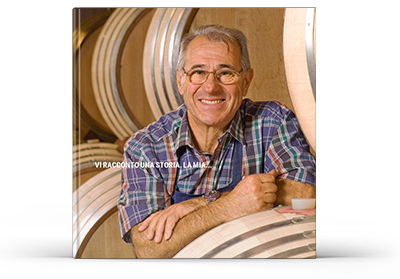
In Depth
Peter Dipoli, born in 1954, is originally from Laives (BZ). His studies at the Istituto Agrario di San Michele all'Adige and his youthful experience at the Laimburg Experimental Station in Auer, in Alto Adige, together with his origins from a farming family, oriented him towards the wine world, as a producer and later also as a market operator. The Azienda Agricola Dipoli is today based in Egna (BZ). He preserves a clear and precious memory of Luciano.
His first contacts with Barolo date back to the early Seventies, when, in his trips to Langa, he encountered with admiration historic producers such as Aldo Conterno of Monforte d'Alba and the Fratelli Cavallotto of Castiglione Falletto.
"I got to know Luciano – Peter recalls – in the mid-Eighties, in his historic cellar, along the road that climbs into the heart of the village of Barolo. That period would bring great changes to that world. And not only because in 1986 the methanol scandal had broken out. There was beginning to manifest itself a comparison-clash, also generational, between two types of producers: the innovators and the traditionalists or, to use my own language, between the hooligans and the classics".
"The elements characterising the innovators – Peter continues – lay in sometimes drastic summer cluster thinning, in the production of rigorously "clean" wines and in the use, at times excessive, of barriques. The traditionalists responded with less forced thinning, with the use of large barrels, often unfortunately defective, and with a livelier and more authentic expression of the territory".
In those years, Luciano found himself working and producing his wines between these two attitudes, often in contradiction with each other. Though subjected to solicitations from both sides, Luciano never embraced either cause, continuing his autonomous path, strengthened by his long experience from having worked for at least twenty years first at Giacomo Borgogno and then at Marchesi di Barolo.
"In him and in his way of approaching production in the vineyard and cellar – Peter specifies – his 'hidden pride' always prevailed, an attitude he had drawn partly from his character and partly from his constant quest marked by frequent trips to Burgundy. With admirable clarity he traced a path entirely his own, without letting himself get embroiled in controversies and without getting too carried away when the results he had achieved would have allowed it".
Over the years, the situation in the Alba wine world gradually stabilised thanks to the positive contamination between the two currents of producers: many disputes faded away and a productive philosophy and working style emerged that proved to be the synthesis between those so divergent positions.
"In this evolution – Peter underlines – Luciano came out a winner, but a victory he never trumpeted to the four winds, but kept to himself, for that hidden pride that inspired him in all his expressions. Withdrawn by character, in some ways essential, at a first meeting he did not allow himself to be easily drawn in. He spoke little and wanted to get to know the person he had in front of him. When familiarity then took over, he became a different person: he opened up to his interlocutor and that apparent simplicity became that of a man rich in personality and complexity of thought. Only a man so profound could lead vineyard and cellar to produce an extraordinary Barolo like his Cannubi Boschis 1990, which I have always admired".
Download the book in PDF and let yourself be guided
through a story that intertwines a man, his land
and the family that preserves his legacy.