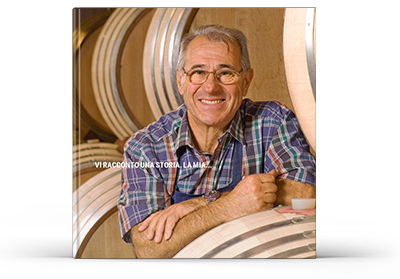
Download the book in PDF and let yourself be guided
through a story that intertwines a man, his land
and the family that preserves his legacy.
In Depth
Born in 1954 in Alba, where he still resides in the historic centre of the city, Fulvio Prandi is deeply connected to the viticulture of the surrounding hills, both as an oenologist, and as an entrepreneur in the supply of oenological equipment and machinery. For many years he was the fiduciary of the Alba branch of Slow Food. His relationship with Luciano was very close and extended over time.
"I have thought about it many times, – Fulvio Prandi begins – but I have never understood
whether between us friendship or the bond of work prevailed. In any case, it was an intense
bond that gave us satisfaction. I recall the first meeting with Luciano at Marchesi di
Barolo in the Eighties. I remember him in that large cellar with his blue apron in
Burgundian winegrower style, a way of dressing that distinguished him throughout his life".
Is there a memory from those Eighties that has stayed in your heart?
"It was the middle of that decade – Fulvio recounts – and, with Luciano and Roberto Vezza (at
the time oenologist at Marchesi di Barolo), we had planned a trip to Burgundy. I knew the deep
bond that Luciano had with that region and so I tried to organise that trip in the best possible
way. I even managed to get us received at Romanée-Contì, the best known and most admired estate in
that area. Even then we noticed that Burgundy was frequented by many wine enthusiasts from all
over the world. We returned home with a feeling of envy, but consoled ourselves with the thought
that we still had a great deal of work to do".
What struck you about Luciano during that trip?
"I noticed immediately that he was extremely attentive. He had understood that in those cellars
they worked in a rigorous and advanced manner. Luciano was like a sponge: he absorbed
everything he saw and turned it into professional baggage. Obviously he did so for the
company where he worked, but in perspective he also did so for himself, for that project of a
cellar entirely his own that he already had in his thoughts".
What became of him then, on his journey?
"Luciano for me – Fulvio recalls – was always a 'learned man' in the broadest sense of the
term; he knew his work in depth and if something was not clear to him he did everything to
understand it better. On many aspects of his work one could call him a conservative, on others an
innovator. But he was so in a natural way, without forcing it".
In your opinion, what was his relationship with the Langhe and Roero like?
"First of all – Fulvio specifies – he was a concrete interpreter of the customs of viticulture
that he knew well and shared for the strong bond he had with the territory. Luciano, moreover, knew
in depth the events of Barolo and Barolo wine, knew Langa and Roero and his decision to invest in
Valmaggiore in the Roero of Vezza d'Alba is symptomatic".
Is there an attitude of Luciano's that always struck you?
"Certainly. Luciano – Fulvio observes – knew very well that the role of the trade press
was important in creating the image of a company. But he never chased it because he
never sought visibility. He was convinced that if a wine had merit it would establish itself
through work and commitment, without shortcuts".
Is there a wine of Luciano's that has always fascinated you?
"It would be easy to say Barolo. My heart has always beaten for his Dolcetto d'Alba,
elegant, immediate, of an absolute frankness that makes the grape variety and territory prevail
over market expectations. Before pleasing others, every wine of his had to please him first".
Download the book in PDF and let yourself be guided
through a story that intertwines a man, his land
and the family that preserves his legacy.