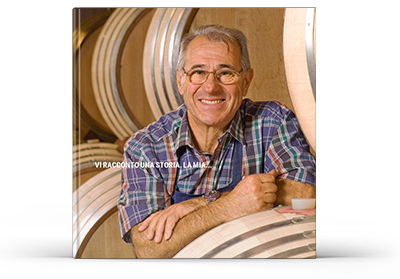
Download the book in PDF and let yourself be guided
through a story that intertwines a man, his land
and the family that preserves his legacy.
Chapter 16
From Monferrato in origin and residence (he lives in Moncalvo, in the province of Asti), Mario Ronco is the oenologist of Cantina Luciano Sandrone. After eight years of valuable professional experience, in 1998 Ronco began collaborating with Luciano Sandrone and with his brother Luca, of whom he had been a classmate at the Istituto Tecnico Enologico Umberto I in Alba.
"I got to know Luciano – Mario Ronco begins – in 1998, when I arrived at his company as a consulting oenologist. About him I knew of the passion for Barolo and the desire to produce it at the highest quality level, from the conversations I had had with his brother Luca, who had been my classmate at the Oenological School. In person, however, I had never met him. When we met, I saw in him a dynamic man, attentive to others' opinions. He had his own ideas, he knew how to behave in the most varied productive situations, but he also wanted to know the solution that whoever was at his side might propose. For this reason, Luciano gave you trust, listened to you, made no distinctions by age or rank. He was ready and willing to compare himself with everyone. But then he put you to the test".
What made the strongest impression on you about his character and his way of doing things?
"Luciano was a very polite and judicious person. But at the same time he was direct and decisive in his way of doing things and in his relationships with others, and for this reason he could also appear brusque. Certainly, he demanded, but he did so in the right way, valuing people and recognising everyone's merits. This way of his always pleased me greatly".
In your role as consultant you have dealt with and compared yourself with many producers. What did you most appreciate about Luciano from a professional point of view?
"What always fascinated me was his irrepressible desire to improve himself. By nature he was very curious, but this desire of his to know and understand was not an end in itself, but was aimed at improving his work in the vineyard and in the cellar. He was not content with hearsay or appearances. He wanted to verify things for himself. For this reason we made many trips together, especially aimed at understanding how the great wine zones of the world worked, and then acting accordingly. We were in France many times, particularly in the most organised regions such as Burgundy, Bordeaux, Alsace and Champagne; and then in the Ribera del Duero in Spain, in Israel, in Lebanon, in Georgia, Hungary, Porto, the Moselle, without overlooking the finest Italian wine realities".
A memory from these exploratory trips?
"I could tell you a thousand situations, but I will limit myself to the one that for me remains the most emblematic: it was 2008 and the world of vine and wine at European level had had to face a difficult phytosanitary situation. Wanting to understand how the situation was in Burgundy, Luciano wanted to see it for himself. So, one morning in that September we set off very early and went to Burgundy. In this way, we understood how phytosanitary problems had also been heavy in Burgundy and how the producers of that region had worked to keep those so negative situations under control. In comparisons with producers from other zones I was always struck by Luciano's open-mindedness. In every place, he sought ideas for self-improvement. Even in wine zones not directly linked to his wines. Let me explain: for a Barolo producer it is obvious to study the reds of Burgundy; whereas it can seem more difficult to learn something from the Moselle or Hungary. It means looking at the wine world from a different angle. Therefore, every time Luciano evaluated cellar or vineyard operations trying to understand whether there were any that could also be applied in Langa".
I understand that Luciano was curious at table too and attentive to the cuisine of other territories…
"On our travels around the wine world, Luciano always revealed great attention to the various cuisines we encountered. Perhaps we would stay in simple, unpretentious places, but for eating we always made interesting discoveries. Whether they were Michelin-starred establishments or well-reviewed ones, or whether they were places unknown to most but where the local cuisine had a fine interpretation. I don't know how he found them, but even in this his curiosity was such that he always had surprises in store for you".
And how did he translate his infinite desire to improve into concrete work?
"There were no secrets or miraculous recipes. Together we carried out an infinite number of trials and checks both in the vineyard and in the cellar. The objective was always the same: to find the most suitable solution to improve the quality and pleasurability of the wine. In him there was no frenzy to excel, but only that healthy desire to improve himself and increase the quality of the final product. To have doubts, he said, ultimately makes one grow. How can one disagree?".
Download the book in PDF and let yourself be guided
through a story that intertwines a man, his land
and the family that preserves his legacy.