Download the book in PDF and let yourself be guided
through a story that intertwines a man, his land
and the family that preserves his legacy.
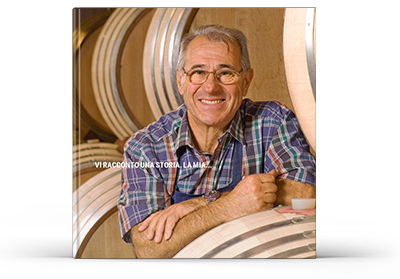
Chapter 17
Roberto Vezza was born in the Conforzo district in the municipality of Diano d'Alba, but a stone's throw from Grinzane Cavour. Born in 1952, he grew up in a farming family tied to viticulture and so he quickly understood that the Oenological School of Alba was the most suited to his character and his expectations. Qualified as an oenologist in 1972 – a critical vintage, in which neither Barolo nor Barbaresco had been produced – after some professional experience in the sector, in September 1977 he arrived at Marchesi di Barolo in Barolo. In this cellar he found as cellarman Luciano Sandrone, who had been there for some years.
"The first time I met Luciano – Roberto Vezza begins – I found a somewhat nervous young man, in some ways somewhat disoriented. He seemed dissatisfied with his work and, as the days passed, I understood why. At work as in life Luciano was meticulous, precise, proud of what he did, but in the company there were some technical shortcomings that needed to be resolved and, before I arrived, he had the feeling that nobody had noticed them. My arrival at Marchesi di Barolo had been facilitated by Enol. Renato Ratti, who at the time directed the Consorzio del Barolo e del Barbaresco. After some months, professional competencies were clarified: I was assigned the role of technical director, Luciano that of cellarman. We looked each other in the eye and understood that we would have to work hard to steer the company towards the best organisational and productive situation. But since work frightened neither me nor Luciano, we quickly found the right path. It was at that moment that I got to know the "real" Luciano. We tasted wines together, identified areas for growth and quickly found the most appropriate solutions. I realised that Luciano had excellent training, even though he had only attended a vocational school. He had made up for the lack of specific schooling with a self-taught preparation from books he had bought and read carefully. I realised I had with me a cellarman whose competence was above average".
Do you have any more specific memories of that period?
"There are many memories – Roberto specifies – also because that was a still embryonic period of what would later become the renaissance of the wine sector in Langa and Roero. Seeing things through the eyes of today, it seems almost impossible that back then one could not get the vineyard to talk to the cellar. And yet it was so: everyone went their own way. The vineyard produced the raw material, but did not know if it was right for the cellar. A few more years would have to pass before arriving at vineyard management aimed at the quality of the grapes and wines. Let alone cluster thinning! At the time the most fertile lands produced well over the maximum yield allowed by the various production regulations, but it seemed that was fine. On the other hand, the winemakers were not willing to pay an adequate price for the grapes and so the grower made up for the excessively low unit price by increasing the quantity per hectare. From the daily conversations I had with Luciano it was clear that both of us would have known what to do, but one had to find the right arguments to convince not only the growers, but also those who produced and vinified on their own. It was long and arduous work, lasting about ten years, but in the end having the right ideas allowed us to find the most adequate solutions".
What finally made people change their minds?
"In this regard, the Eighties were decisive. It is true that in the middle of that decade, in 1986, the serious methanol scandal broke out, but that was only the tip of the iceberg. The phase of renewal was already underway also because precisely in that period a generation of winegrowers' children was beginning to appear on the scene of the Alba wine sector, who were starting to look around and ask themselves why in France, more precisely in Burgundy, wines were sold at prices we were unable to match. So, together with Renato Ratti, Massimo Martinelli and many others, we made many study trips to Burgundy. They were illuminating trips that made us understand that on one hand one had to do things properly, both in the vineyard and in the cellar, without shortcuts. And on the other hand one had to agree and all speak the same language, without criticising or contradicting each other. Moreover, from those trips we learnt that one had to make more elegant wines. There was no point in producing Barolos too rich in tannin that would need years to find their harmony. One had to create from the outset wines aimed at harmony and elegance".
From your account one gets the sense that you and Luciano grew up together. Am I wrong?
"You are absolutely not wrong. – Roberto affirms – Luciano and I truly grew up together and in a synchronous manner. We did so in the work carried out at Marchesi di Barolo, of which we were both proud. Then we would do so in our two cellars: the professional and entrepreneurial stimulus was important for both of us and together we followed extremely virtuous paths, which did good to the companies where we worked. No problem we encountered along the way frightened us. One simply had to find the right solutions and locate the most reliable collaborators to help us resolve them".
Seeing him now in memory, how was Luciano at work?
"Above all – Roberto recalls – Luciano was in love with his work and performed it with enthusiasm wherever he was: it was so at Marchesi di Barolo, but he remained that way in his own cellar. Moreover, Luciano knew how to do many things simultaneously. Not only that: if the work cost no sacrifice for him it had no value. You became aware of Luciano's importance not so much when he was working, but in those few moments when he was absent. And he was always there: at Marchesi di Barolo, during harvest, he was always available and you would find him in the cellar even on Saturday or Sunday when the others were rightly off on their own".
Can you tell me something about Luciano's character?
"Luciano – Roberto recalls – had a strong, significant personality, which in certain situations could make it seem difficult in his way of doing and being. But one had to know how to relate to him and in this I never had any problems. At work he needed his presence to count for something because he was proud of what he did. But in a balanced relationship there were no problems because Luciano was transparent and direct. Everything else, including that character that some described as rough and gruff, was more appearance than anything else".
You were able to spend time with Luciano outside of work too. How was he on leisure occasions?
"Many times – Roberto becomes serious and is almost moved – we spent entire days without work. We enjoyed going fishing together. It was a shared passion. On these occasions we would go mainly to the mountains and spent truly relaxing moments. Fishing was the excuse to be together. Then we would end up eating something, opening a few bottles. I remember that once we went to Lago Superiore in Valle Po. I had a passion for scuba diving and on that occasion Luciano helped me carry the compressed air cylinders for the dive up to altitude. I still remember now his measured but decisive way of tackling things, even when it was not a matter of work. He approached everything with commitment and the utmost attention".
If I understand correctly, you continued to see each other with a certain regularity even after Luciano left Marchesi di Barolo. How were your relations in later years?
"With Luciano – Roberto reflects – we did not have fixed appointments. We knew each other's habits. For example, he knew that every morning I went for breakfast at a café in Gallo Grinzane and so every now and then I would find him there waiting for me or arriving unexpectedly. They were moments of serenity and relaxation for both of us. We chatted about this and that, commented on the events and happenings in the wine world. We also told each other about the changes we had made at work or in the cellar. I knew that at work he demanded a great deal, from others but also from himself. I remember for example that in the tying of the vines he insisted at all costs on using osier and so we would start to reason about the pros and cons.
In recent years those periodic meetings at the café became a little less frequent and gave me an image of Luciano increasingly tried. I watched him little by little growing older, feeling more tired, even though in his eyes there was always that wonderful light of former times. That image of Luciano little by little becoming older has stayed in my heart and I carry it with me as the memory of a friend who was close to me for so many years".
Download the book in PDF and let yourself be guided
through a story that intertwines a man, his land
and the family that preserves his legacy.