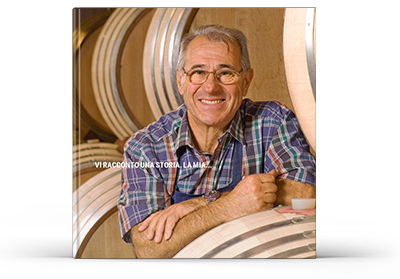
Download the book in PDF and let yourself be guided
through a story that intertwines a man, his land
and the family that preserves his legacy.
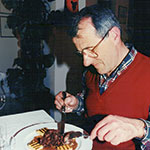
At the table he had a great passion for Langa cuisine, but without exaggerations.
“First of all – Mariuccia specifies – Luciano was tremendously interested in cooking and was
also a gourmet. I remember that when he had to leave for a business trip, he researched the
cuisine of those places in detail, imagining how he could pair it with his wines. But the beauty
was hearing him tell of his experiences upon his return. He invariably came out with a
“criticism”. But for us in the family it was nothing new”.
Many were his favorite dishes among those of Langa, traditional or with some curious variation
that came from the “imagination” of mother Rosina.
“The most evident example – recalls Mariuccia – was that of tajarin with meat sauce, which his
mother, depending on the season, completed with rich handfuls of peas from the garden, tender
and sweet. With this slightly unusual touch, the flavor of childhood remained with him and so
Luciano, throughout his life, continued to appreciate it. He loved this dish with its variation
in Sunday lunches, here at home, together with the family, especially to pass these tastes on
to his grandchildren, Alessia and Stefano. And, wonder of wonders, now they love them too”.
Among the traditional Langa dishes he particularly loved Russian salad, the vitello
tonnato, but – careful! – in the traditional version, i.e. without mayonnaise, the “vitel tané”
to be clear.
As for the first courses, he was mainly between the r̄avior̄e der̄ plin (ravioli in the
feminine as per local tradition) and soups – in particular the cisr̄à – or minestre –
especially the “mnestr̄a da bàte er̄ gr̄an”; and then the sauces and the bagnet such
as bàgna càda, bagnet verd and sàussa do dijav.
But his curiosity at the table also pushed him towards dishes of the most orthodox Langa cuisine
such as batsoà, oriòt and finanziera. Dishes difficult to find on the restaurant menu, but
still very much appreciated in the family. Among the second courses, he preferred rabbit, which
he loved Ligurian style with Taggiasca olives or in red wine (his Barbera d’Alba) or with
Carmagnola peppers.
“As I said – specifies Mariuccia – Luciano was a gourmet, but a failure at cooking. I will
never forget that evening when, after work, I had to go to the dentist. Barbara, our daughter,
had 4 years old. Knowing Luciano's limits in the kitchen, I had taken care to leave dinner ready
for the child: the pot with the water already salted, next to it in a bowl the right amount of
pasta and also the appropriate doses of extra virgin olive oil and Parmigiano Reggiano... and
obviously the colander. Back home, I was very happy as I had noticed that the child had eaten
and was actually already sleeping. Tidying up the pots in the kitchen, I realized that the
colander had not been used. I asked Luciano if by any chance he had already rinsed it, but he,
with all the naturalness in the world, asked me: “Ah, but what was the colander for?” After
this question, I had yet another confirmation that Luciano in the kitchen was a <master in
disaster!!>. He had given the child the pasta in its cooking water with the oil and the
Parmigiano! What a soup!”.
On the contrary, he loved very much carrying out some traditions of preserves that went back to
the times when the refrigerator did not yet exist or was very rare. So he enjoyed macerating
Carmagnola peppers in the pomace still in fermentation, the so-called “povr̄on sota r̄a
ràpa”. And then, at the end of autumn, pinzimonio with Cervere leeks that Luciano matured
in sand for months was mandatory. But his “exploit” was wine vinegar, which at first he prepared
with his mother Rosina. Then he continued the family tradition by preparing it in a small wooden
barrel together with his brother Luca who today continues the precious family custom.
As a young man, Luciano was very reserved, perhaps even a little shy, and this made him appear aloof. It was an attitude that was disorienting and gave the impression that he was a difficult person to involve.
The vine and the vineyard had a privileged place in Luciano's heart. And this since he was young.
Let's come to the topic of "sport". It cannot be said that Luciano had any particular preferences. He was not a fan of any team, but – if it happened to him – he would gladly watch a football match on television or even better the stages of the Giro d'Italia.
Luciano's life was dotted with many pleasant moments, many occasions that moved him.
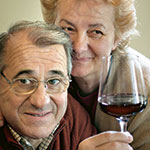
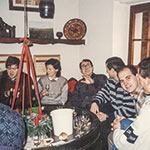
At home, Luciano was “allergic and intolerant” to household chores. He loved hospitality, the warmth of the table, he liked to celebrate anniversaries, to be with loved ones, all together.
Download the book in PDF and let yourself be guided
through a story that intertwines a man, his land
and the family that preserves his legacy.