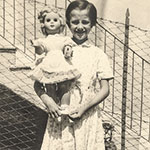
2.5 The meeting between Luciano and Mariuccia
The meeting with Mariuccia soon proved promising. It is true that their characters were
very different, but little by little they complemented each other. Indeed, for both of
them this encounter was a true enrichment. They quickly came to understand that the
situations binding them together far outnumbered those that might divide them.
And so, after a couple of years, precisely on 20 April 1969, they married. Both were
very young: Luciano was 23 and Mariuccia even younger. But they already had a clear
idea of what they wanted. They knew that the union of two such different yet easily
complementary characters could give rise to a beautiful story. And so it was.
"Newly married," — Luciano recalls — "we went to live in the heart of the village of
Barolo, in a house belonging to the Abbona family, just a stone's throw from the
manorial castle, right where the Corkscrew Museum now stands. In that house — when I
had first started working at Marchesi di Barolo — there had been another wine
producer, also belonging to the Abbona family, but they were gradually winding it down.
Naturally, I was looking for accommodation independent of my family of origin, and that
solution seemed the most suitable for our needs and our means".
The year 1969 was set to prove generous with positive developments, and so in September
of that year Mariuccia too began working at Marchesi di Barolo. Being able to count on
two incomes gave them peace of mind, also in view of possible future developments.
And besides, they were both made for work, and this situation only further consolidated
their bond.
But the most important development was still to come, and it materialised a year and a
half after their wedding. On 3 October 1970, Barbara was born, their daughter.
At that point, they felt an even greater sense of responsibility to do well. There were
no longer just the two of them sharing a life. A daughter had been added, for whom they
wanted to reserve a future full of bright promise.
Meanwhile, the Barolo wine had resumed its forward march. The DOC recognition had
established fixed points that had not previously existed, or had only been the result
of private agreements. The Decree of 23 April 1966 brought with it a Production
Disciplinary, which set out the main rules for producing Barolo: the production zone,
the grape variety, the quantity of grapes that could be produced per hectare, the
yield of grapes into wine, the duration of ageing and the physical, chemical and
organoleptic characteristics that had to be present in the product ready for
consumption. All rules that in the previous recognition as a Vino Tipico in the 1930s
had not appeared, or only in a vague way: that decree had only defined the zone of
origin of the grapes and the grape variety, then too Nebbiolo. But it had imposed no
further regulations, leaving the various producers wide freedom of interpretation.
The law of the 1920s establishing the Vini Tipici had provided for the possibility
that the producers of each "Vino Tipico" could form a Consorzio di Difesa del Vino
Tipico di Pregio, and that this body should be charged with setting out the production
rules in greater detail. To distinguish wines produced by member companies from the
general production, the consortium could devise and grant to its associated producers
a quality mark to be affixed to individual bottles.
As far as Barolo was concerned, the experience accumulated in its Consorzio
(established in conjunction with Barbaresco in 1934) had fed into the new production
disciplinary. The appellation of origin had reawakened interest in Barolo and its
world, a path of vitality that would never again be interrupted.