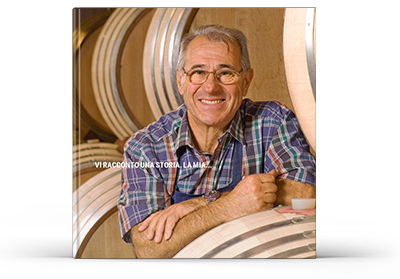
Download the book in PDF and let yourself be guided
through a story that intertwines a man, his land
and the family that preserves his legacy.
“Indeed, that was how it was: there were not yet too many producers, but compared to the previous decades their number had already grown and many of them believed in the new development and in a strategy that put origin and the area's potential at the centre of progress. Moreover, the positioning of Barolo had also grown, having assumed the characteristics of a prestigious and classy wine that knew how to resist time and compete with the great wines of the world. The market itself shared Barolo's new dimension and was constantly searching for high-quality wines of certain origin to take around the world, creating a development that, in these dimensions and at such speed, would never be repeated. The growth of Barolo in identity, image and economic valuation in that period became exponential.”
In this so tumultuous phase, how was Luciano?
“The great development of Barolo never excited him too much: Luciano always remained very cautious. He still had the memory of the lean years on his skin and therefore even in this so positive phase he did not let himself be flattered. At an associative level, he remained very attached to the first association he had joined, the 'Piccoli Produttori dei Grandi Vini del Piemonte' (Small Producers of Great Piedmont Wines), which had marked the relaunch of small-scale agricultural estates and which Luciano had experienced as his second home. Above all, he did not share the triumphalist attitudes of some of his colleagues. Compared to others, he was more cautious, more controlled and less noisy. He preferred concreteness to 'spatuss' (ostentation), as they say in good Piedmontese. This way of being was seen in many things, beginning with the car he used. He wanted a car that was in good order and legal, but always of a moderate type. I remember that when he decided to buy an Alfa Romeo Giulia, he did so quietly and preferring a second-hand car to a new one. Always with the aim of not making too much show. It was his nature.”
After primary school I went to the Oenological School, in Alba.
In 1987, when I graduated, the company was not in a position to guarantee me a job: Luciano was still at Marchesi di Barolo.
Authoritativeness was the hallmark of his professional journey. In some cases he gave the impression of being authoritarian, so confident was he of himself and his decisions.
Download the book in PDF and let yourself be guided
through a story that intertwines a man, his land
and the family that preserves his legacy.