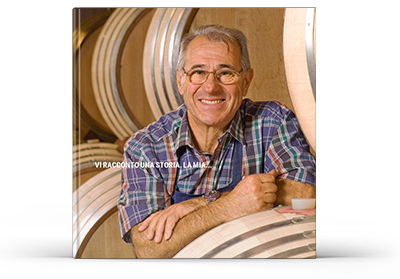
Download the book in PDF and let yourself be guided
through a story that intertwines a man, his land
and the family that preserves his legacy.
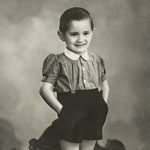
Throughout the entire period of his childhood and adolescence, and even into early youth, Luciano
always spoke little. When he walked through the streets of the village, the girls would devour him with
their eyes. He was a handsome young man, but he did not give too much encouragement. Even then he was a reserved type, who rarely frequented the village gathering places such as the bar or the square. He did not behave this way to seem important, but because that was simply his nature.
Indeed, whenever someone needed something, Luciano would go out of his way to help.
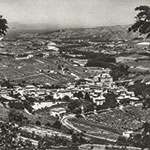
In Barolo, Luciano's family lived in the historic centre, near the Giacomo Borgogno cellar. So Cav. Cesare Borgogno naturally knew him and had noticed his particular inclination for the land, agriculture and related activities. He had immediately sensed that Luciano would be a positive asset for his company and so he did everything possible to persuade him to come and work for him.
"Cav. Borgogno was so keen on me that he had enlisted my father in his persuasion campaign. Every day, when I came home from school, my father would remind me that 'the knight' had asked after me and was waiting for another meeting. That constant pressure little by little bore fruit and, at the end of my Avviamento years, he convinced me to go and work at the Cantina Giacomo Borgogno. There are many memories from those years. One, for example, takes me back to 1963. I was just 17 years old and was already working at Borgogno.
I remember that in November of that year all of us employees at that cellar were summoned
to the Town Hall in Barolo for a meeting on wine matters. It was on that very occasion that
the news arrived that in Dallas, in the United States, the American president
John Kennedy had been assassinated. It was the afternoon of 22 November 1963 and my small world connected with the world at large".
The carefree days of childhood and adolescence were over. The age of reason and maturity was beginning, with its far more pressing and
concrete opportunities.
Looking back on those times, Luciano picks up the thread of his story: "In an era when families were often large, mine was small, simple and unpretentious.
As we have seen, the family's origins were in La Morra, but the move to Barolo came fairly early, when Luciano was only a few months old.
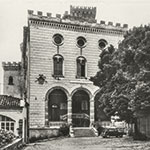
In 1952, upon turning six years of age, Luciano began primary school, attending the five years of this course in the castle of Barolo.
Download the book in PDF and let yourself be guided
through a story that intertwines a man, his land
and the family that preserves his legacy.