Download the book in PDF and let yourself be guided
through a story that intertwines a man, his land
and the family that preserves his legacy.
As we have seen, the family's origins were in La Morra, but the move to Barolo
came fairly early, when Luciano was only a few months old. This is also why Luciano has
always felt himself to be a "Barolese" in every sense.
The reasons for the move from La Morra to Barolo were linked to father Ottavio's trade.
Working as a carpenter and having accumulated fine experience in various artisan workshops, he had
many work offers. And, besides, he was a skilled craftsman and so the various workshops were all vying for his services.
Father Ottavio often recalled having had the good fortune to work for a few years in a large
carpentry workshop in Savigliano, a traditional and well-organised artisan business that produced
mainly furniture and furnishing accessories. And it produced rather elaborate furniture too, with
various carved and finely crafted parts. An experience that would stand him in good stead
in subsequent years. It is true that he was a carpenter, but in his work he constantly revealed
that touch of originality and artistic approach that made him very well regarded.
In Barolo he began to work at the Mozzone carpentry workshop, but he stayed there only a few years. He was eager
to embark on his own independent path and so he decided to set up on his own, opening
his own workshop. Those years between the late Forties and early Fifties were
difficult: there was plenty of work, but little money. But he immediately demonstrated his strong
entrepreneurial spirit.
"In Barolo, in his workshop, – Luciano recalls – my father mainly produced door and window frames, but
the fact that in the village there were many cellars that needed the carpenter for
maintenance of their barrels and their cellar equipment meant that he also specialised
in that sector: he repaired the vats, in particular the closing hatches (the ghigét
as they are called in Piedmontese), removed tartrates from the internal surfaces, made small and
large containers for wine such as tubs, buckets, baskets (àr-bi) and more. And then,
for this production section, he often went to the plain between Fossano, Savigliano and Cuneo to
buy mulberry wood, particularly suited to such work. And it happened that he would take me
along and so I began to travel around the province of Cuneo. And I greatly enjoyed it".
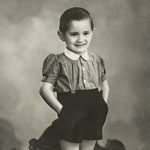
Looking back on those times, Luciano picks up the thread of his story: "In an era when families were often large, mine was small, simple and unpretentious.
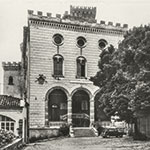
In 1952, upon turning six years of age, Luciano began primary school, attending the five years of this course in the castle of Barolo.
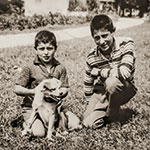
Throughout the entire period of his childhood and adolescence, and even into early youth, Luciano always spoke little.
Download the book in PDF and let yourself be guided
through a story that intertwines a man, his land
and the family that preserves his legacy.